

Cyclades
The ring of islands around sacred Delos — Santorini's caldera, Mykonos, Syros and whitewashed villages above the sea.
Explore CycladesDiscover Cyclades
More than two hundred islands and islets scatter across the central Aegean, though fewer than twenty are permanently inhabited. What unites them — beyond their position in the same bright sea — is a landscape shaped by sun, wind and the patient agriculture of people who learned to work with very little water. Steep, rocky hillsides give way to terraced fields of olive and grapevine. In spring, wild herbs scent the air: thyme, sage, oregano. Summer turns the ground brown and the sea a deep, steady blue.
Villages and Architecture
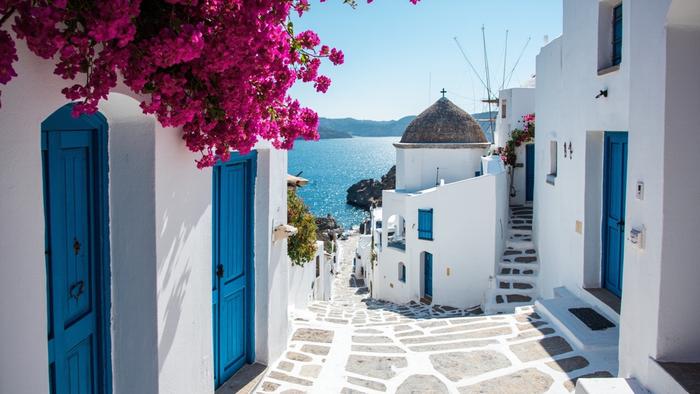
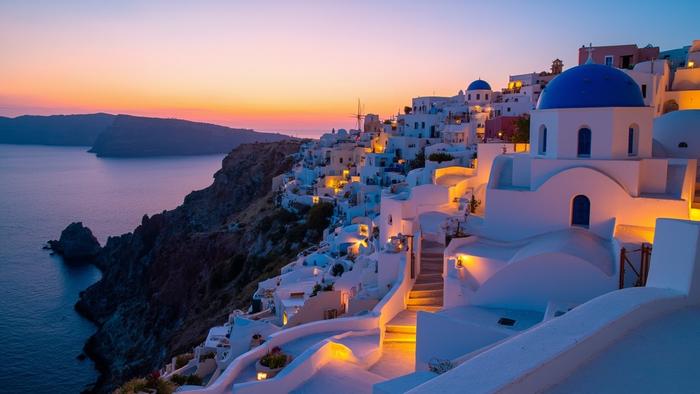
The Cycladic village is one of the most recognisable human settlements in Europe. Cubic white houses with flat roofs crowd hillsides, their windows and doors painted in blue or ochre. Narrow stepped lanes twist between them, rising from a small harbour to a hilltop church or a ruined Venetian castle. Every island has at least one village like this — Hora — and on most islands, the Hora is still lived in rather than merely photographed, though the balance shifts sharply in high summer.
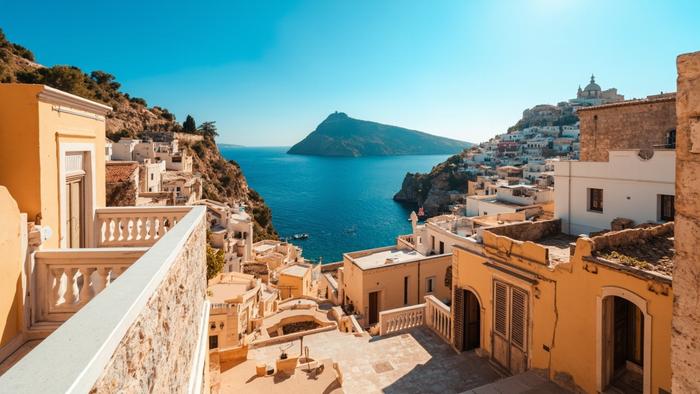
Beyond the whitewashed core, older settlements sprawl across hillsides in a different way: dry-stone walls terrace the slopes in intricate patterns, marking boundaries, containing soil and directing rainwater.
History in Stone
The Cyclades have been inhabited since at least the Neolithic period, and the islands are famous for the marble figurines — most recognisably, the seated harpist from Halandriani on Syros — produced during the Early Bronze Age. In the 1st millennium BCE, Delos was one of the most important sanctuaries in the Greek world, a sacred island where religious festivals drew visitors from across the Mediterranean.
Later centuries layered different presences over these islands: Byzantine churches tucked into cave walls, Frankish castles on hilltops, Ottoman-era neighbourhoods alongside older quarters. On some islands, this layering is visible in a single walk from harbour to upper town.
Food and Daily Life
The islands produce more than tourism. Olive oil — peppery and strong — comes from small groves tended on terraced slopes. Local cheese, particularly varieties of graviera and feta, appears on most taverna menus. On Naxos, the island's comparatively fertile central plain supplies vegetables, fruit and wine. In island ports, fishing boats land small catches: octopus hung to dry on harbour lines, grouper and snapper served grilled the same afternoon.
Eating well here does not require seeking out a particular restaurant. It means finding a harbourfront table in a small island town, ordering whatever the kitchen has that morning, and letting the pace slow to match the pace of the place.
- 4 places to discover
- 1 small-group tours
- 8 travellers, maximum
Map of Cyclades
Discover the main towns, sites and natural wonders. Click on a marker to learn more about each place.
Places in Cyclades
-
-
-


Explore our tours in Cyclades

