

Sahara & the South
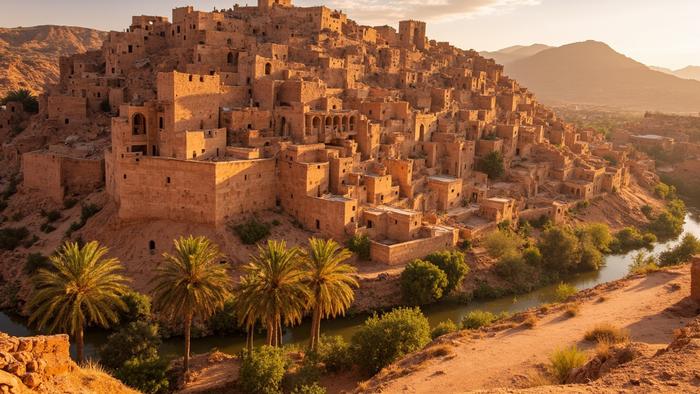
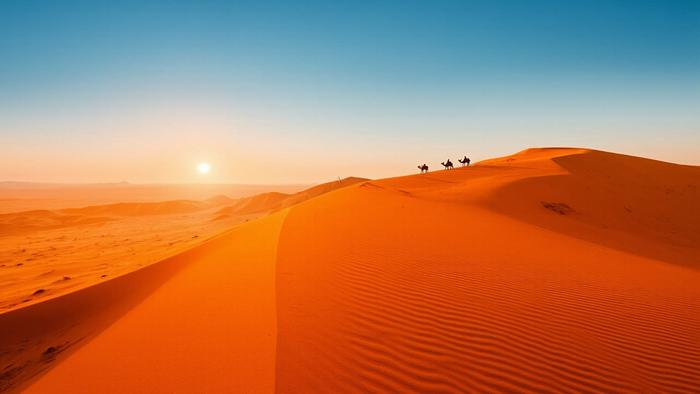
Kasbahs, the Draa valley and the dunes of Erg Chebbi beyond the High Atlas.
Explore Sahara & the SouthDiscover Sahara & the South
Morocco's south is defined by contrast. The land grows drier as you travel from the High Atlas, the ochre earth giving way to rocky hammada, then — suddenly — to sudden corridors of green where rivers break through and date palms crowd close. It is a region where the word "desert" does not mean emptiness but a particular kind of fullness: sky, light, silence, and a harsh hospitality that shapes everything that lives here.
Kasbah Country
The landscape is punctuated by kasbahs — fortified earthen compounds built from the local mud and straw, rising in towers and crenellated walls that were once the only protection for families, their grain, and their livestock. Many now stand partially ruinous, their upper storeys crumbled, but the best have been sensitively restored. Walking through their low doorways into cool interior courtyards, you sense how architecture here was shaped entirely by climate and security.
The Draa Valley stretches south-east from the foothills, a long green scar of date-palm gardens and small settlements. The road through it passes a string of kasbahs at irregular intervals, some still inhabited, others occupied by the swallows that nest each spring in their upper rooms. Beyond Zagora, the palms thin, the river dries to a rocky bed, and the desert proper begins.
Sand and Stone
The dunes of Erg Chebbi near Merzouga are the most accessible Saharan dunes in Morocco. The largest rise over 150 metres; the wind reshapes them constantly, erasing the tracks that cross them by morning. At dawn they hold a pale, cool light; by mid-afternoon they are hot underfoot and deep gold in colour. A night spent in a desert camp away from the road brings the full silence — not an absence of sound but a presence of quiet so complete it takes time to become accustomed to.
Ouarzazate is the practical hub of the region, its streets built from the same rose-coloured local stone that gives the town its warmth. Film studios on its edge have been operating since the 1950s; the town has a lived-in market character rather than a museum one. Nearby, the ksar of Ait Benhaddou rises from the river plain in a dense cluster of towers and outer walls — a fortified village that has appeared in dozens of films and remains partly inhabited, its streets a close, cool labyrinth in summer heat.
Gorges and Rose Gardens
The Todra Gorge is a sharp change of register. A river has cut a canyon through the plateau, leaving walls that rise 300 metres above a narrow floor. The gorge narrows to ten metres across in places; the temperature drops noticeably in its depths. A path follows the river through the canyon and emerges into the valley beyond, where gardens of olive, almond, and carob grow in the shade of the gorge's mouth.
The Rose Valley around Kelaa des M'Gouna produces the damask roses that are harvested each May and processed into rose water and attar of roses. The industry is modest in scale — cooperatives and small family operations — and the smell of roses in bloom during the harvest season is one of the region's most unexpected and immediate pleasures.
- 2 places to discover
- 0 small-group tours
- 8 travellers, maximum
Map of Sahara & the South
Discover the main towns, sites and natural wonders. Click on a marker to learn more about each place.
Places in Sahara & the South
-
-


Explore our tours in Sahara & the South
No tours visit this place just yet — tell us where you want to go and we'll build one. See all tours
